
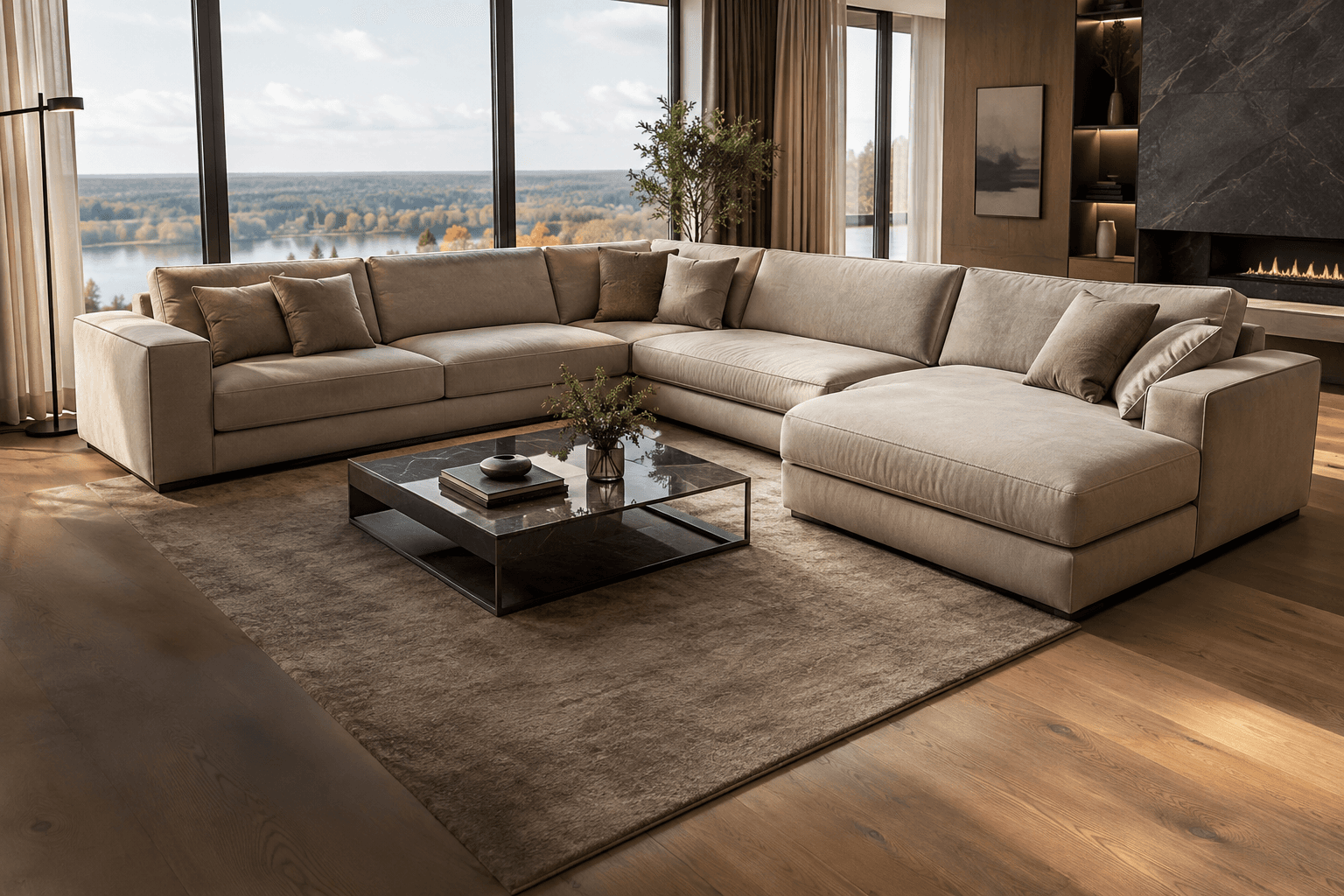
Modular furniture offers more layout options, but first plan the room, everyday movement and the pieces you need.
Measure the modules and leave room to move
Draw a room plan and note the dimensions of each section, not just the overall sofa length. Mark the corner, end pieces and any extensions. The usable floor area changes depending on whether you choose a freestanding, straight or corner arrangement.
Outline the sections with tape and check that there is still space for a walkway, table and nearby furniture. Measure the route the modules will take into the room and find out whether they are delivered separately.
Choose modules to suit everyday habits
Think about where people usually sit and how conversation flows in the room. A chaise section may be useful in the evenings, while a broad corner can suit family time. Do not choose a module just because it appears in a configuration: consider whether it matches your habits.
Ask how the sections connect, whether they can be rearranged and which pieces are needed to create a left- or right-hand corner. These questions also matter if you expect the room to change in the future.
Find out what “modular” means for the specific model
Not every modular sofa can be rearranged in the same way. Some sections have a fixed connection side or shape; others may have connectors, covers or accessories intended only for particular combinations.
Before ordering, request a drawing and dimensions for the chosen configuration. Make sure you understand which pieces are included, which must be ordered separately and whether additions will be possible later. The maker’s information is the safest basis for your decision.